

What Animals Head Did Shiva Put On His Son, Ganesha's Body
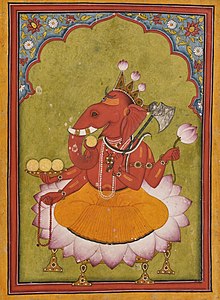
There are many anecdotes of Ganesha. Ganesha's elephant head makes him easy to identify.[1] He is worshipped every bit the lord of beginnings and every bit the lord of removing obstacles,[ii] the patron of arts and sciences, and the god of intellect and wisdom.[iii] In his survey of Ganesha'southward rise to prominence in Sanskrit literature, Ludo Rocher notes that:
Above all, 1 cannot assist being struck past the fact that the numerous stories surrounding Gaṇeśa concentrate on an unexpectedly limited number of incidents. These incidents are mainly iii: his nascency and parenthood, his elephant caput, and his single tusk. Other incidents are touched on in the texts, simply to a far lesser extent.[4]
History about the birth of Ganesha are found in the afterward Puranas, composed from virtually 600 CE onwards. References to Ganesha in the earlier Puranas, such as the Vayu and Brahmanda Puranas are considered to exist afterward interpolations made during the 7th to 10th centuries.[5]
Birth and childhood [edit]
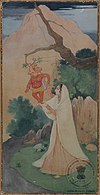
Parvati playing with infant Ganesha
While Ganesha is popularly considered to be the son of Shiva and Parvati, the Puranic myths chronicle several different versions of his birth.[six] [7] These include versions in which he is created by Shiva,[eight] by Parvati,[ix] past Shiva and Parvati,[10] or in a mysterious way that is later discovered by Shiva and Parvati.[eleven]
The family includes his brother Kartikeya.[12] Regional differences dictate the gild of their births. In North Bharat, Skanda is generally said to be the elder brother while in the South, Ganesha is considered the first born.[thirteen] Prior to the emergence of Ganesha, Skanda had a long and glorious history equally an important martial deity from about 500 BCE to most 600 CE, when his worship declined significantly in North Bharat. The period of this decline is concurrent with the rising of Ganesha. Several stories relate episodes of sibling rivalry between Ganesha and Skanda[14] and may reflect historical tensions between the respective sects.[fifteen]
Once there was a competition betwixt Ganesha and his brother to run into who could circumambulate the three worlds faster and hence win the fruit of knowledge. Skanda went off on a journey to cover the 3 worlds while Ganesha simply circumambulated his parents. When asked why he did so, he answered that his parents Shiva and Parvati constituted the three worlds and was thus given the fruit of cognition.
Elephant head [edit]
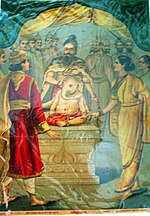
Hindu mythology presents many stories, which explain how Ganesha obtained his elephant or gaja caput. Often, the origin of this particular attribute is to exist constitute in the same anecdotes which tell about his birth. The stories also reveal the origins of the enormous popularity of his cult. Devotees sometimes interpret his elephant head as indicating intelligence, discriminative power, fidelity, or other attributes thought to be had by elephants. The big elephant ears are said to denote wisdom and the ability to heed to people who seek help.
Decapitation past Shiva [edit]

A mutual 4-armed form of Ganesha. Miniature of Nurpur school (circa 1810). Museum of Chandigarh.[16]
The almost well-known story is probably the one taken from the Shiva Purana. The goddess Parvati had started preparing for a bath. As she did not want to exist disturbed during her bath and since Nandi was not at Kailash to keep guard of the door, Parvati took the turmeric paste (for bathing) from her body and fabricated a statue of a boy, breathing life into him. This boy was instructed by Parvati to baby-sit the door and to not let anyone in until she had finished her bath.
Later on Shiva had come out of his meditation, he wished to meet Parvati, but found himself being halted by a strange boy. Shiva tried to reason with the boy, proverb that he was Parvati's husband, but the boy did non mind and was determined to keep Shiva at bay. The boy's behaviour surprised Shiva. Sensing that this was no ordinary boy, the usually even tempered Shiva decided he would have to fight the boy and in his divine fury, severed the boy'due south head with his trishul, killing him instantly.
When Parvati heard word of this, she was so enraged that she decided to destroy all of creation. At her call, several ferocious multi-armed forms, the yoginis, arose from her body and threatened annihilation. Lord Brahma, being the creator, naturally had his concerns, and pleaded that she reconsider her desperate plan. She acquiesced with two weather condition: one, that the male child be brought back to life, and two, that he be forever revered before all the other gods in prayer.
Shiva, having cooled down by this point, agreed to Parvati's weather. He sent his devotees out with orders to bring back the head of the first creature that lay with its head facing the due north. They presently returned with the head of a strong and powerful elephant named Gajasura, which Lord Brahma placed atop the boy's body. Animate new life into him, he was declared as the Gajanana and offered him the condition of beingness the foremost among the gods in prayer, and the title of the leader of all the ganas (classes of beings), Ganapati.
Shiva and Gajasura [edit]

Once, in that location existed an Asura (demon) with all the characteristics of an elephant, called Gajasura, who was undergoing a penitence (tapas). Shiva, satisfied by this austerity, decided to grant him, as a reward, any souvenir he desired. The demon wished that he could emanate fire continually from his ain torso so that no one could always dare to approach him. The Lord granted him his request. Gajasura continued his penitence and Shiva, who appeared in front end of him from time to time, asked him once once more what he desired. The demon responded: "I desire that You inhabit my stomach." Shiva agreed.
Parvati sought him everywhere without results. As a final recourse, she went to her brother Vishnu, request him to find her hubby. He, who knows everything, reassured her: "Don't worry, dear sister, your married man is Bhola Shankara and promptly grants to his devotees any they enquire of him, without regard for the consequences; for this reason, I think he has gotten himself into some trouble. I will find out what has happened."
Then Vishnu, the omniscient director of the cosmic game, staged a modest one-act. He transformed Nandi (the bull of Shiva) into a dancing bull and conducted him in front end of Gajasura, assuming, at the same time, the appearance of a flutist. The enchanting operation of the bull sent the demon into ecstasies, and he asked the flutist to tell him what he desired. The musical Vishnu responded: "Can you requite me that which I ask?" Gajasura replied: "Who do you take me for? I can immediately give you whatsoever you inquire." The flutist then said: "If that's then, liberate Shiva from your stomach." Gajasura understood then that this must have been no other than Vishnu himself, the but one who could have known that clandestine and he threw himself at his feet. Having agreed to liberate Shiva, Gajasura asks him for ii last gifts: "I have been blessed by you with many gifts; my concluding requests are that everyone should recollect me adoring my head and you lot should wear my skin."
Gaze of Shani [edit]
A bottom known story from the Brahma Vaivarta Purana narrates a dissimilar version of Ganesha's birth. On the insistence of Shiva, Parvati fasted for years (punyaka vrata) to propitiate Vishnu and so that he would grant her a son. Vishnu, after the completion of the sacrifice, announced that he would incarnate himself as her son in every kalpa (eon). Appropriately, Ganesha was born to Parvati every bit a mannerly babe. This event was celebrated with keen enthusiasm and all the gods were invited to take a look at the baby. However Shani (Saturn), the son of Surya, hesitated to look at the baby since Shani was cursed with the gaze of destruction. Shani came to a decision and looked at the goddess Parvati's infant from the edge of his left eye.[17] However Parvati insisted that he look at the baby, which Shani did, and immediately the babe's head fell off. Seeing Shiva and Parvati grief-stricken, Vishnu mounted on Garuda, his divine hawkeye, and rushed to the banks of the Pushpa-Bhadra river, from where he brought back the head of a young elephant. The head of the elephant was joined with the headless body of Parvati'south son, thus reviving him. The infant was named Ganesha and all the Gods blest Ganesha and wished Him ability and prosperity.[18]
Other versions [edit]
Another tale of Ganesha's birth relates to an incident in which Shiva slew Aditya(Lord sun), the son of a sage. Shiva restored life to the dead boy, but this could non pacify the outraged sage Kashyapa, who was 1 of the vii great Rishis. Kashyap cursed Shiva and declared that Shiva's son would lose his head. When this happened, the caput of Indra's elephant was used to replace it.
Still another tale states that on one occasion, Parvati'south used bath-h2o was thrown into the Ganges, and this water was drunk by the elephant-headed Goddess Malini, who gave nascency to a baby with four artillery and five elephant heads. The river goddess Ganga claimed him as her son, merely Shiva alleged him to be Parvati's son, reduced his five heads to 1 and enthroned him every bit the controller of obstacles (Vignesha).[19]
Cleaved tusk [edit]

Vyasa narrating the Mahabharata to Ganesha, his scribe, Angkor Wat
There are diverse anecdotes which explain how Ganesha broke off i of his tusks. Devotees sometimes say that his single tusk indicates his ability to overcome all forms of dualism. In Bharat, an elephant with 1 tusk is sometimes called a "Ganesh".
Ganesha the scribe [edit]
In the start part of the epic poem Mahabharata, it is written that the sage Vyasa ( Vyāsa ) asked Ganesha to transcribe the verse form equally he dictated information technology to him. Ganesha agreed, merely just on the condition that Vyasa recite the poem uninterrupted, without pausing. The sage, in his turn, posed the condition that Ganesha would not only have to write, but would have to understand everything that he heard before writing it down. In this way, Vyasa might recuperate a bit from his continuous talking past simply reciting a difficult verse which Ganesha could not understand. The dictation began, only in the rush of writing Ganesha's feather pen broke. He broke off a tusk and used it every bit a pen so that the transcription could proceed without interruption, permitting him to go on his word.
This is the single passage in which Ganesha appears in that epic. The story is non accepted as office of the original text by the editors of the disquisitional edition of the Mahabharata,[20] where the twenty-line story is relegated to a footnote to an appendix.[21] Ganesha's association with mental agility and learning is probably ane reason he is shown as scribe for Vyasa'southward dictation of the Mahabharata in this interpolation to the text.[22] Brownish dates the story as 8th century CE, and Moriz Winternitz concludes that it was known as early as c. 900 CE just he maintains that it had not notwithstanding been added to the Mahabharata some 150 years later. Winternitz also drew attention to the fact that a distinctive feature of Southern manuscripts of the Mahabharata is their omission of this Ganesha legend.[23]
Ganesha and Parashurama [edit]
1 mean solar day, Parashurama, an avatar of Vishnu, went to pay a visit to Shiva, just along the fashion he was blocked by Ganesha. Parashurama hurled himself at Ganesha with his axe and Ganesha (knowing that this axe was given to him by Shiva) immune himself, out of respect for his begetter, to be struck and lost his tusk every bit a effect.[24] By this lord Ganesha yells out of hurting and goddess Parvati comes running out from the cavern. She, looking at the condition of her son asks Kartikeya what happened. When she learns virtually Parashurama and that he was the reason for the axing off of 1 of the tusks of her honey son lord Ganesha, she assumes the form of Goddess Kali and threatens to slay the sage for his actions. At that time, Parashurama remembers lord Krishna. Lord Vishnu goes to that place and disguised himself equally a small brahmin boy. Later on he tells lord Shiva that he had arrived to that identify in order to sort out the affair betwixt Parashurama and goddess Parvati. He preaches the Ganesha Naamaashtaka Stotra and asks Parashurama to please the supreme goddess Parvati by reciting holy hymns on her. Parashurama does the aforementioned, as a effect of which goddess Parvati gets pacified and blesses the Parashurama.[25]
Ganesha and the Moon [edit]
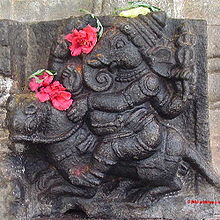
Ganesha riding on his mountain Dinka, mouse.
After coming back from the feast at Kubera's palace, Ganapati was riding on his mouse Dinka on the way home. Information technology was a total moon that dark. As he was riding, Dinka saw a snake and ran behind a bush. Ganapati fell to the footing, and his breadbasket broke open. Ganapati started to put the food back in his breadbasket. The moon god Chandra saw him and started laughing loudly. Angered by this, Ganapati pronounced a curse on the moon god: "Y'all shall be always blackness and never be seen by anyone." Frightened past the curse, the moon god started pleading for mercy. Ganapati said "Okay, but you shall be changing from new moon to full moon. Too if anyone sees the moon on my birthday, he or she shall non attain moksha (liberation)." The moon god kept repose. Later Ganapati had finished putting the food in his tum, he took the snake and tied information technology around his belly. Then he continued back home.
Head of the angelic armies [edit]
There in one case took place a bang-up competition betwixt the Devas to decide who among them should be the head of the Gana (the troops of semi-gods at the service of Shiva). The competitors were required to circle the world as fast as possible and return to the Feet of Parvati. The gods took off, each on his or her own vehicle, and fifty-fifty Ganesha participated with enthusiasm in the race; merely he was extremely heavy and was riding on Dinka, a mouse! Naturally, his pace was remarkably slow and this was a great disadvantage. He had not yet made much headway when there appeared before him the sage Narada (son of Brahma), who asked him where he was going. Ganesha was very annoyed and went into a rage because it was considered unlucky to encounter a solitary Brahmin but at the beginning of a voyage. Nonetheless the fact that Narada was the greatest of Brahmins, son of Brahma himself, this was still a bad omen. Moreover, information technology wasn't considered a good sign to be asked where ane was heading when ane was already on the style to some destination; therefore, Ganesha felt doubly unfortunate. Nonetheless, the great Brahmin succeeded in calming his fury. Ganesha explained to him the motives for his sadness and his terrible desire to win. Narada consoled and exhorted him not to despair; he said that for a kid, the whole world was embodied within the female parent, so all Ganesha had to practice was to circle his Parvati and he would defeat those who had more speed but less agreement.
Ganesha returned to his mother, who asked him how he was able to end the race so speedily. Ganesha told him of his encounter with Narada and of the Brahmin's counsel. Parvati, satisfied with this response, pronounced her son the winner and, from that moment on, he was acclaimed with the name of Ganapati (conductor of the angelic armies)[26] and Vinayaka (lord of all beings).[27]
Ambition [edit]
1 anecdote, taken from the Purana, narrates that the treasurer of Svarga (paradise) and god of wealth, Kubera, went one solar day to Mountain Kailash in order to receive the darshan (vision) of Shiva. Since he was extremely vain, he invited Shiva to a feast in his fabulous city, Alakapuri, so that he could show off to him all of his wealth. Shiva smiled and said to him: "I cannot come, but you can invite my son Ganesha. Merely I warn you that he is a voracious eater." Unperturbed, Kubera felt confident that he could satisfy even the well-nigh clamorous appetite, like that of Ganesha, with his opulence. He took the lilliputian son of Shiva with him into his great city. In that location, he offered him a ceremonial bathroom and dressed him in sumptuous clothing. After these initial rites, the great banquet began. While the servants of Kubera were working themselves to the bone in club to bring the portions, the little Ganesha just continued to eat and eat and eat. His appetite did non decrease fifty-fifty after he had devoured the servings which were destined for the other guests. There was non even time to substitute i plate with another because Ganesha had already devoured everything, and with gestures of impatience, continued waiting for more food. Having devoured everything which had been prepared, Ganesha began eating the decorations, the tableware, the piece of furniture, the chandelier. Terrified, Kubera prostrated himself in front of the piffling omnivorous ane and supplicated him to spare him, at least, the rest of the palace.
"I am hungry. If you don't give me something else to eat, I will eat y'all also!", he said to Kubera. Desperate, Kubera rushed to mount Kailasa to ask Shiva to remedy the situation. The Lord then gave him a handful of roasted rice, saying that something as simple as a handful of roasted rice would satiate Ganesha, if it were offered with humility and love. Ganesha had swallowed upward about the entire urban center when Kubera finally arrived and humbly gave him the rice. With that, Ganesha was finally satisfied and calmed.
References [edit]
- ^ Martin-Dubost, p. two.
- ^ These ideas are so common that Courtright uses them in the title of his volume, Gaṇeśa : Lord of Obstacles, Lord of Ancestry.
- ^ Heras, p. 58.
- ^ Brownish, p. 73.
- ^ Krishan, p. 103.
- ^ For a summary of Puranic variants of birth stories, see Nagar, pp. 7-14.
- ^ Martin-Dubost, pp. 41-82.
- ^ Linga Purana.
- ^ Shiva Purana IV. 17.47-57 and Matsya Purana 154.547.
- ^ Varāha Purana 23.xviii-59.
- ^ Brahmavaivarta Purana, Ganesha Khanda, 10.viii-37.
- ^ For a summary of variant names for Skanda, run into Thapan, p. 300 and Brown, p. 355.
- ^ Khokar and Saraswati, p.4.
- ^ Brown, pp. 4, 79.
- ^ Gupta, p. 38.
- ^ Martin-Dubost, p. 64.
- ^ HS, ANUSHA (2020). Stories on lord Ganesh series -thirteen: From various sources of Ganesh Purana. Independently published (March 27, 2020). pp. number 15. ISBN979-8631217102.
- ^ Barratt, Barnaby (Dec 2009). "Ganesha's lessons for psychoanalysis: Notes on fathers and sons, sexuality and death". Psychoanalysis, Culture & Society. 4 (fourteen): 317–336. doi:x.1057/pcs.2008.53. S2CID 144642792.
- ^ For the proper name Vighnesha, see Courtright pp. 156, 213.
- ^ Brown, pp. 71-72.
- ^ Mahābhārata, Vol. i, Part two. Critical edition, p. 884.
- ^ Brownish, p. 4.
- ^ Winternitz, Moris. " Gaṇeśsa in the Mahābhārata". Journal of the Royal Asiatic Society of Groovy Britain and Ireland (1898:382).
Dark-brown, p. 80. - ^ "Ganesha". IndianCultureOnline.com. Gurjari.net. Retrieved 2006-09-28 .
- ^ HS, ANUSHA (2021). Stories on lord Ganesh series - twenty: From diverse sources of Ganesh Purana. Independently published (April 6, 2020). pp. summary of xx pages cited. ISBN979-8634399676.
- ^ Apte, p. 395
- ^ Thapan, p. xx.
- Apte, Vaman Shivram (1965). The Applied Sanskrit Dictionary. Delhi: Motilal Banarsidass Publishers. ISBN81-208-0567-iv. (quaternary revised & enlarged edition).
- Brown, Robert L. (1991). Ganesh: Studies of an Asian God. Albany: Land University of New York. ISBN0-7914-0657-1.
- Courtright, Paul B. (1985). Gaṇeśa : Lord of Obstacles, Lord of Beginnings. New York: Oxford University Printing. ISBN0-19-505742-2.
- Gupta, Shakti Grand. (1988). Karttikeya: The Son of Shiva. Bombay: Somaiya Publications Pvt. Ltd. ISBN81-7039-186-5.
- Heras, H. (1972). The Problem of Ganapati. Delhi: Indological Book Firm.
- Krishan, Yuvraj (1999). Gaņeśa: Unravelling An Enigma. Delhi: Motilal Banarsidass Publishers. ISBN81-208-1413-4.
- Martin-Dubost, Paul (1997). Gaņeśa: The Enchanter of the Iii Worlds. Bombay: Projection for Indian Cultural Studies. ISBN81-900184-3-4.
- Nagar, Shanti Lal (1992). The Cult of Vinayaka. New Delhi: Intellectual Publishing House. ISBN 81-7076-043-ix.
- Saraswati, South.; Ashish Khokar (2005). Ganesha-Karttikeya. New Delhi: Rupa and Co. ISBN81-291-0776-seven.
- Thapan, Anita Raina (1997). Understanding Gaņapati: Insights into the Dynamics of a Cult. New Delhi: Manohar Publishers. ISBN81-7304-195-4.
Source: https://en.wikipedia.org/wiki/Mythological_anecdotes_of_Ganesha
Posted by: horneables1985.blogspot.com
0 Response to "What Animals Head Did Shiva Put On His Son, Ganesha's Body"
Post a Comment